Bending Terms

Bend Allowance
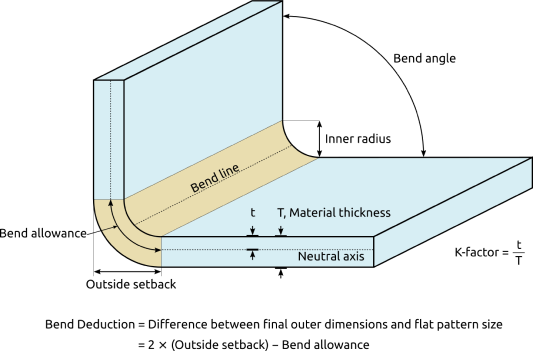
The length of material that will be deformed during the bend. It is strongly recommended to avoid placing holes or other cutouts in the bend allowance region—unless they are centered directly under the bend line. Otherwise, the bend will be pulled toward the holes, changing the size of the finished part.
Bend Angle
The angle between the two flanges of the bent part. Values less than 90 degrees are more closed (acute), and values between 90 and 180 degrees are more open.
Bend Deduction
The difference between the final dimensions of the bent part, as measured on the outer surface, and the original size of the flat part. This value is often used to calculate the size of the flat that will result in a desired final dimension. For example, to create an L-bracket where each side is 6 inches long, if the bend deduction is 0.5 inch, the flat part should be 11.5 inches long.
Bend Line
The line where the punch will contact the part. When you select a line in your drawing to be bent, we will position the punch on that line.
Inner Radius
The approximate radius of the inside of the bend. Bends are not exactly circular, so this value is more of a design parameter, rather than an actual measurement.
K-factor
A coefficient that describes the location of the neutral axis. It is a measure of the tendency of the material to either compress or stretch during bending. The K-factor is around 0.4 for soft metals like aluminum, and around 0.45 for harder metals like steel and stainless.
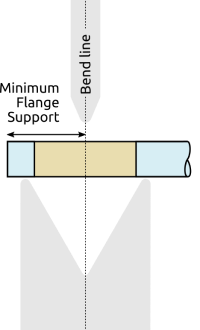
Minimum Flange Support
The minimum distance between the bend line and the edge of the material. Material within the minimum flange support region will contact the die during bending. A larger bend radius uses a larger die, so it requires more flange support. We recommend minimizing the number of holes or other cutouts in the flange support region, to ensure the most accurate bends.
Maximum Bend Length
The maximum length of a bend that can be made with a certain inner radius. This is limited by both the physical size and tonnage capacity of our press brake.
Neutral Axis
The point in the interior of the material that neither stretches not compresses during bending.
Outside Setback
In the finished part, the distance from the beginning of the bend allowance region to the outer surface of the flange.

80CRV2 Chrome-Vanadium Steel

High carbon, chrome-vanadium alloy steel. This material is wear-resistant and workable, suitable for high-end blades.
Common Uses
Common use 1 - Longer name example here
Details here Lorem ipsum dolor sit amet, consectetur adipiscing elit.
Common use 2
Details here Lorem ipsum dolor sit amet, consectetur adipiscing elit.
Common use 3 - Medium length
Details here Lorem ipsum dolor sit amet, consectetur adipiscing elit.

Available Sheet Thicknesses

Material Details
Thickness
0.125" (1/8")
Thickness Tolerance
+/- 0.003"
Material
Steel, 80CRV2
Type
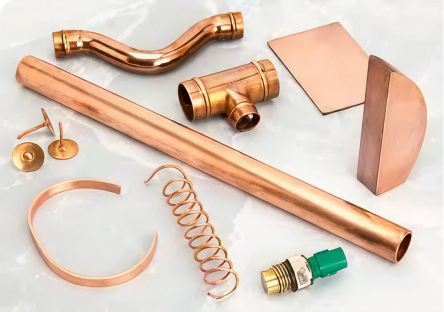
Copper
Alloy
Copper 101, H00 to H01 temper
Finish
Mill Finish
Protective Film
0
Thickness
0.125" (1/8")
Supported Services
Bead Blasting
Countersinking
Flat Finishing (Metal Deburring & Graining)
Powder Coating
Centrifugal Tumbling
Design Rules
Maximum Part Size
35.500" x 11.500"
Minimum Part Size (length or width)
0.100"
Min Recommended Hole Size
0
Min Hole Size
0
Min Recommended Channel Width
0
Min Recommended Wall Thickness
0
Max Recommended Aspect Ratio
30
Kerf (Laser Cut Width)
0
Material Properties
*Note: Physical and mechanical properties are not guaranteed. They are intended only as a basis for comparison and not for design purposes.
Tensile Strength (Ultimate)
26 ksi
Tensile Strength (Yield)
6 ksi
Brinell Hardness
55 kgf / mm^2
Elongation at Break
20%
Bend Parameters
K-Factor
To learn more about minimum flange support, bend deduction, or maximum bend length, please press the button below.
Minimum Flange Support
Material Details
Thickness
0.188" (3/16")
Thickness Tolerance
+/- 0.003"
Material
Steel, 80CRV2
Type
Copper
Alloy
Copper 101, H00 to H01 temper
Finish
Mill Finish
Protective Film
0
Thickness
0.188" (3/16")
Supported Services
Bead Blasting
Countersinking
Flat Finishing (Metal Deburring & Graining)
Powder Coating
Centrifugal Tumbling
Design Rules
Maximum Part Size
35.500" x 11.500"
Minimum Part Size (length or width)
0.100"
Min Recommended Hole Size
0
Min Hole Size
0
Min Recommended Channel Width
0
Min Recommended Wall Thickness
0
Max Recommended Aspect Ratio
30
Kerf (Laser Cut Width)
0
Material Properties
*Note: Physical and mechanical properties are not guaranteed. They are intended only as a basis for comparison and not for design purposes.
Tensile Strength (Ultimate)
26 ksi
Tensile Strength (Yield)
6 ksi
Brinell Hardness
55 kgf / mm^2
Elongation at Break
20%
Bend Parameters
K-Factor
To learn more about minimum flange support, bend deduction, or maximum bend length, please press the button below.
Minimum Flange Support
Supported Services
Resources & Guidelines
Add a concise value statement that captures reader interest and previews content value. Focus on benefits while keeping it under two lines. Align with your blog categories.
Min/Max Part Sizes
A quick guide for how small or large your metal parts can be.
Finishing Options
Browse our various finishing options for your metal parts.
Materials Catalogue
Browse our extensive list of available materials.
Design Guidlines
Tips for designing your metal parts without a hitch.
Laser Cutting Guidelines
All the tips you need for your laser cutting projects
Material Selection Guide
Not sure which material to select? This guide will help.

FAQ

What does "fully-nested pricing" mean?

We take all the custom metal parts in your order and "nest" them on sheet metal, to get the best material price. Other online metal cutting services don't offer nested pricing. Multi-part metal cutting jobs usually benefit greatly from nesting, so it's an important part of bidding on online laser cutting jobs. Be sure to log in and click "Continue" to get the final price of your metal parts.

What are your lead-times for fabricated sheet metal parts?

Our standard lead-time is 2 business days for prototype and short-run laser cutting jobs, but there are options during checkout for lead-times as quick as same-day, depending on job size, material availability, and capacity. As a standard practice, we'll cut your job early when we can, regardless of the order size.

Can you meet a lead-time not listed during checkout?

Unfortunately not. Our lead-time engine is tied closely to our production planning software, which monitors production capacity. During peak demand, we can't guarantee a faster lead even if your job is small.

Can you cut a material not listed in your catalog?

We can't, but we often add materials based on customer demand. Please let us know if you have a special request by sending us an email to quote@oshcut.com.

Do you support sheet metal bending?

We do! You can upload a 3D model of your sheet metal part in STEP or SolidWorks format, and our platform will automatically unfold your metal part to create a flat pattern and bend program. You can also upload a flat pattern and select bend lines if that's easier for you. Whatever method you use, you can watch a bend simulation that shows how your part will form on our equipment, alerting you of potential issues right away.

How can I get better prices?

Our system automatically applies aggressive pricing discounts as your metal cutting and bending job increases in size. To get the best price, upload more parts or increase your order quantities. OSH Cut is most competitive for mid-to-large sheet metal fabrication jobs containing multiple custom metal parts, parts that benefit from nesting, and parts that include bending.

Can you ship internationally?

We currently offer shipping in the United States only. Shipping heavy sheet metal parts internationally is usually impractical, so there generally isn't significant demand. We may offer international shipping in the future, however.

Will you remove the burr on my parts?

Absolutely! Our lasers usually cut without leaving a burr, but you can select deburring to eliminate any potential burrs on thicker materials. Make sure that after you upload your part, you select deburring as an option. We can deburr your parts and optionally put a 240-grit linear grain on your parts. Not all parts have enough surface area to support deburring, but our system will let you know what is available after upload.

Upload Your Design for instant pricing